Saturday, September 24, 2016

If you are scared of a zero carbon economy, you are confusing "carbon free" with "climate change."

Bill McKibben:   "[I]f our goal is to keep the Earth’s temperature from rising more than two degrees Celsius—the upper limit identified by the nations of the world—how much more new digging and drilling can we do?

Here’s the answer: zero.
That’s right: If we’re serious about preventing catastrophic warming, the new study shows, we can’t dig any new coal mines, drill any new fields, build any more pipelines. Not a single one. We’re done expanding the fossil fuel frontier. Our only hope is a swift, managed decline in the production of all carbon-based energy from the fields we’ve already put in production.
... 
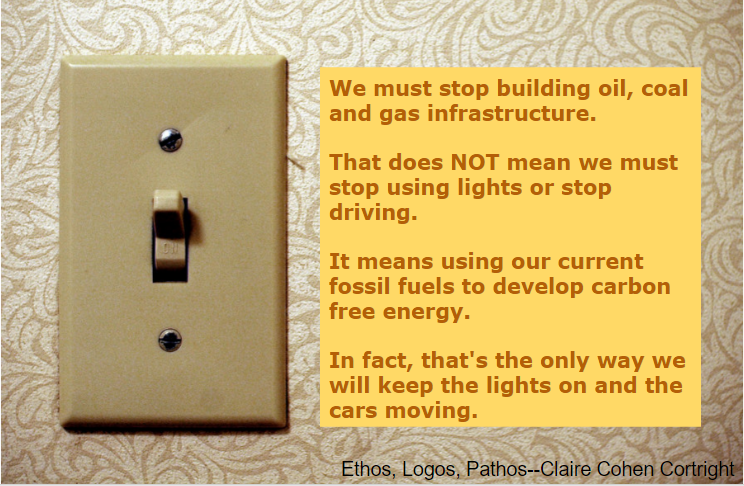
'Managed decline' means we don’t have to grind everything to a halt tomorrow; we can keep extracting fuel from existing oil wells and gas fields and coal mines. But we can’t go explore for new ones. We can’t even develop the ones we already know about, the ones right next to our current projects." 
Action on climate does not mean living in caves.

Action on climate does not mean hunting around in the dark.

Action on climate does not mean living without power.

That's what happens if we DON'T act on climate.

Friday, September 16, 2016

An Open Letter to My Children

A wonderful project, called Dear Tomorrow, is collecting letters from people to their children, and others, who will be living in the future.  The letters will be held in a time capsule and released in 2030 and in 2050.  I had to write mine.  It's not an easy task.  My own children are alternately afraid of a Trump presidency and of creepy noises.  One foot in childhood and one foot in adulthood.  I share my fears and hopes with them, but I am wary of overwhelming them with the worst.  They have lives to lead, and hearts to break and jokes to tell.  They deserve to keep that.  Here is my letter.  I will share it with them today and submit it to the project.


Dear C and K,

I love you both.  

I want the world for you.  I have always wanted the world for you.  I want for you to love and laugh and live.  From the day each of you came into my life, I have tried to surround you with all that is good.  When you were infants, I played Mozart's music and decorated with vibrant colors, We explored the world with little special trips to the zoo and the woods and the library.  Even the grocery store was an adventure.  As you grew, I sent you to the Montessori school and then to dance because it was best for you.  I have made sure you had holidays and that I created traditions to make them special.

I want to continue to do that for you.   Your needs have changed over time, but the fact that you have needs has not.  You will need to build a means of making an income, you will need food on the table, you will need homes, you will need time and space to enjoy yourselves, to love, to laugh and to live.

So as you stepped out of the nursery, and I looked around at the wider world, I realized that Mozart's music and vibrant colors are no longer how to create the world I want for you. Something more dire is in its way.  Climate change is threatening everything I have to offer you and it is hurtling towards us.

Now, as you move forward, and I fear for what is coming as the planet warms, I read and try to make sense of how we will be impacted.  Anticipating the challenges.  Protecting resources to give you so that you can handle those challenges.  I look at our house, at 1300', with space for growing food and with water that is not subject to fracking and has never failed from drought, and I think I should keep it for you.  I consider the skills you might need, and how to generate resources for yourselves when I can no longer do that.  

I cry sometimes, for the things I know you will not have.  There will be terrible heat waves and sea level rise will drive people from the coasts to where we live.  Crops won't grow as well, so food costs will go up and means of making an income will likely go down.  Little things that aren't really so little will disappear, like coffee and chocolate, taking our traditions with them.  Refugees will come to our shores, and refugees will move within our own borders.  There will be mold growth everywhere.  Diseases like Lyme and Zika will have company.  Civil strife may drive other problems and disrupt your lives.  The world will be a terrifying place.  How terrifying?  I don't know.  But it won't be all Mozart and crib toys.

So what is a mom to do about it?  

Well, teach you the most important things.  The most most most important thing?  There is no such thing as "winning" or "losing" at life.  There are wins and losses.  But your life's journey is not a game to win or lose.  It is your journey.  Yours.  Every generation before you has faced struggles, pain and hardship.  And yours will too.  

But every generation before you has had a chance to love, to laugh and to live.  Take yours.  Take it.  Love.  Laugh.  Live.

But know this.  Loving, laughing and living does not mean saying "screw it" to life's challenges.  It means taking them on.  It means caring enough about your world and your life to try to make it better, even when it is terrifying.

I don't know if my efforts on climate can truly impact the trajectory of carbon emissions over the next century.  But I want you both to know this.  Every letter I have ever written, every meeting I attended, every article I read, every post I made to move others, every item I reused, every degree I turned the heat down, every load of laundry I hung dry, every luxury I didn't buy and when I am able, every arrest I will subject myself to, these all are the point.   I work on climate because I love you. 

And when you walk out the door on your own, I have one thing to insist on:  whatever you choose to do, do it out of love.  If you do, then whether you succeed or not, your actions have mattered.  Don't ever let anyone tell you your actions don't matter.  Every single thing you do matters.  You matter.

Whatever comes, please know that my actions are yours to keep, and carry with you.  Please let them hold you close when you need them.  It is the most important thing I have to give you, in the end.

With all my love, yours to carry,

Mom

Sunday, September 11, 2016

World War II Scale Mobilization


Climate change is here and it is urgent.  Urgent as in really really really dire.  As I discussed in a previous post, IPCC projections show a 50% chance of staying under 1.5C warming if we get to zero emissions by 2035 and a 66% chance of staying under 2C warming if we get to zero emissions by 2050.

Bill McKibben wrote an excellent piece last month laying out what we need to do to get to zero emissions...a World War II Scale Mobilization to fight climate change.  He did a great job explaining that winning a war is about building weaponry and infrastructure as much as it is about fighting.  He discussed how much needs to be built to fight climate change.  (While I do not completely agree with his reliance on Jacobsen's work to such a degree, his point is well made and whether we rely 100% on renewables or to some lesser extent, we have a lot to get done in a short amount of time).

Then he turned to a discussion of what a World War II Scale Mobilization looks like.  This was excellent.  We must all take a long hard look at what that really means.  Easy to say the phrase and give an air of meaning business, but getting down to brass tacks means figuring out precisely what that entails.
"Turning out more solar panels and wind turbines may not sound like warfare, but it’s exactly what won World War II: not just massive invasions and pitched tank battles and ferocious aerial bombardments, but the wholesale industrial retooling that was needed to build weapons and supply troops on a previously unprecedented scale. Defeating the Nazis required more than brave soldiers. It required building big factories, and building them really, really fast...
According to the conventional view of World War II, American business made all this happen simply because it rolled up its sleeves and went to war. As is so often the case, however, the conventional view is mostly wrong. Yes, there are endless newsreels from the era of patriotic businessmen unrolling blueprints and switching on assembly lines—but that’s largely because those businessmen paid for the films. Their PR departments also put out their own radio serials with titles like “Victory Is Their Business,” and “War of Enterprise,” and published endless newspaper ads boasting of their own patriotism. In reality, many of America’s captains of industry didn’t want much to do with the war until they were dragooned into it."
McKibben goes on to explain that "dragooned into it" meant government agencies directing industry action:
 “'It was public capital that built most of the stuff, not Wall Street,' says Wilson. 'And at the top level of logistics and supply-chain management, the military was the boss. They placed the contracts, they moved the stuff around.' The feds acted aggressively—they would cancel contracts as war needs changed, tossing factories full of people abruptly out of work. If firms refused to take direction, FDR ordered many of them seized. Though companies made money, there was little in the way of profiteering—bad memories from World War I, Wilson says, led to 'robust profit controls,' which were mostly accepted by America’s industrial tycoons. In many cases, federal authorities purposely set up competition between public operations and private factories: The Portsmouth Naval Shipyard built submarines, but so did Electric Boat of Groton, Connecticut. 'They were both quite impressive and productive,' Wilson says."
Let's tease that apart.  "Public capital built most of the stuff... [C]ompanies made money."  Why exactly did "America's industrial tycoons...accept 'robust profit controls'"?  Well, the answer might be in what those industrial tycoons got in return.  Andre Tartare, with Bloomberg:
"To win WWII, the U.S. economy had to be re-tooled to churn out airplanes and tanks alongside (or, in lieu) of washing machines and cars, while at the same time developing new technologies, such as the atomic bomb. Government spending — often in the form of cost-plus contracts to the risk-averse private companies operating the factories and mines — peaked at nearly 43 percent of U.S. gross domestic product in 1943 and 1944." 
A simple definition of cost-plus contract:  "A cost-plus-fixed-fee contract is a cost-reimbursement contract that provides for payment to the contractor of a negotiated fee that is fixed at the inception of the contract... This contract type permits contracting for efforts that might otherwise present too great a risk to contractors.."  That's right.  The corporation takes none of the risk in research and development.  Guaranteed profit.  No risk.  Government takes the risk.

Military and defense contractors.  Gun manufacturers.  Airplane and auto manufacturers. Profiteering?  Maybe not in the sense of making exorbitant profit margins. But they weren't treated too shabbily.  No risk R&D and guaranteed profit is nice.

Don't get me wrong.  I don't think it was a bad move.  We needed to fight a war.  And win a war.  And if IBM and Boeing and others profited by it unfairly, well, such is life.  We had a war to fight and win.

And we need to fight a war now.  We have loads of solar panels and wind turbines to churn out.  We have nuclear R&D to accomplish.  We have a HVDC grid to build.  We have smart grid technology to develop.  We have gardens to grow.  We have replacement for concrete to discover.  We have planes, trains and automobiles to build that move without fossil fuels.  We have energy storage R&D to do. We have to figure out how to accomplish widespread negative emissions.  We have sea level rise to address.  We have extreme weather to defend against.  We have a war to fight.  And we will need to do whatever it takes to win that war.

And here is my point:  it WILL involve decisions that people on the left do not necessarily like.  I don't like the idea of cost-plus contracts to GM or Boeing or Microsoft or, worse, Exxon Mobil.  But what if they mean we can win the war?

If we are going to talk about WWII scale mobilization, we had better be ready to be exceedingly pragmatic. When we talk about WWII scale mobilization, we are talking about TOUGH choices.  Not just for someone like Mitch McConnell or Jim Inhofe.  Not just for Barack Obama or Hillary Clinton.  Tough choices for us all.

I propose that those choices be faced with the guiding principle that cutting emissions and preserving a livable world must take higher priority than retribution, ideology or righteousness.  Bill McKibben is absolutely right.  We CAN get to zero emissions by 2035 or 2050.  But no one should think it will come lightly or easily.

Wednesday, August 31, 2016

Unjust Corporate Profits and Cutting Carbon


Florida, which has the third highest potential for solar energy production, ranks 14th for actual production.  Since 2008, there has been a property tax exemption for homeowners who install photovoltaic solar at their residences, but no similar credit for corporations.

Yesterday, Florida voted for a constitutional amendment giving corporations a property tax exemption for solar installations to be in effect for 20 years, starting in 2018.

The fantastic news is this passed with 73% of the vote.  That demonstrates phenomenal support in a state that has a strong Republican presence.  This is the state whose governor banned state environmental employees from saying "climate change."

This 73% included a wide range of interests, across the political spectrum, right and left:
"Backers of Amendment 4 were all along the political spectrum, including the pro-environment Southern Alliance for Clean Energy, Nature Conservancy, and Florida Conservation Voters, and the business-backed Florida Chamber of Commerce, Florida Retail Federation and Florida Restaurant and Lodging Association."
Those tax breaks are going to likely result in huge amounts of corporate dollars turned to solar infrastructure.  Of course, it will also benefit corporate bottom lines.

And herein lies the interesting wrinkle to this story.  The only opposition reported came from the LEFT:
"The opposition was led by the Rev. Al Sharpton, the TV and radio talk show host and president of the National Action Network, and Bishop Victor Curry of Miami, NAN’s southeast regional director, who said they opposed 'unnecessary and unjust tax breaks for corporations.'”
This is reminiscent of an ongoing challenge in Washington State.  Washington has a ballot proposition to implement a revenue neutral carbon tax.  The biggest opposition is from the Democratic Party and labor unions, who worry that it doesn't raise revenue to be retained to fund government policies. Sierra Club cites the fact that it doesn't raise revenue for clean energy as part of its basis for opposition. (There are questions about whether it actually has an error that makes it revenue losing and that is a legitimate concern, but the opposition to revenue neutrality itself is telling).

These two state initiatives to address climate change are both finding their opposition on the political LEFT.  In each case, it seems to be driven by concern that corporations or private interests will get an unfair break of some kind.

We often assume that it is big business, corporate interests, conservatives and Republicans that are getting in the way of cutting carbon.  But what if it is also the climate concerned left?

In the case of Florida, business got a tax break.  And they will likely invest some of their considerable resources into building renewables infrastructure.

Al Sharpton wasn't happy about it.  Labor unions and Sierra Club aren't happy that Washingtonians may collect money on carbon and give it all back to private citizens without raising revenue.

But here is the question.  How important is it to us to cut carbon emissions?

We have five years left at current emissions before we have lost even a 66% chance of staying under 1.5C warming.  Does Al Sharpton appreciate what will happen to the disempowered, the poor, minorities, women and children when we hit 1.5C?  2C?  3C?  Surely, Sierra Club must, no?  Do we really have time to turn our noses up at policies that will cut emissions just because they help corporate interests?

As these types of questions become more and more frequent, it appears that the political right won't be the only group that has some climate soul searching to do.

Saturday, August 20, 2016

Informed Decisions in a Changing Climate

Can you imagine living through Hurricane Katrina?

As a white woman from the northeastern U.S., I believed that I understood that racism exists, that I have advantages that others do not and that racism matters.

Then, I arrived in New Orleans in August '89 to begin law school.  I drove into the city with a truck full of my possessions.  Ten minutes after crossing into the city, before finding the University, I stopped at a local restaurant. I walked in.  And what I saw stunned me.

There were about ten men working there.  One white man, the rest black men.  The white man was the manager.  And the black men were his subordinates.

The heat was oppressive.  The humidity like nothing I had ever experienced before.  A heavy pall. There was a dull and vague acceptance of a crappy job, oppressive humidity and unquestioned separation of race.  There was a hopelessness in the men's eyes.  No eye contact.  Just "yes, missus" from bowed heads.

I shook off the experience, thinking I was reading more into it than existed.  Perhaps I was just projecting my 1960's preconceived notions.

However, the city never felt like part of the same country I grew up in. Police were corrupt. Government was corrupt. At a level I had never seen before. I watched police officers buy beer while on duty, get into their patrol car, open up and drive off. It was not a good plan to get pulled over by state troopers if you were young and female. That was not speculation. That was reality. The crime rate was huge. Theft, murder, drugs. The animal shelter was so poorly funded that animals' cages were never cleaned. Strays ran rampant. And the homeless children. Boys that had bottle caps in their sneakers and tapped for money. Living on the streets. The interstate between Baton Rouge and New Orleans is known as cancer alley because of the high rate of pollutant-driven cancers.

And, of course, there were poorly maintained levees.

I graduated from law school in May 1992 and moved on.  I gave New Orleans only passing thoughts until August 2005.  And then, along with the rest of the nation and world, looked on in horror as Hurricane Katrina arrived, the most impoverished and disempowered citizens failed to evacuate, the levee failed, Bush's FEMA failed, and the USA looked like a country from the developing world.

Hurricane Katrina floods Canal St.
Aftermath of Hurricane Katrina


Poverty, race, corruption and lack of preparation converged to create horror and suffering.  Rapes and looting and terror-filled nights ensued.

The wealthier folks got out.  But even they did not get off scot-free.  Many people never returned to rebuild their homes and their businesses.  New Orleans' recovery was anemic and slow.

The losses were overwhelming.  "An estimated 1,833 people died in the hurricane and the flooding that followed in late August 2005, and millions of others were left homeless along the Gulf Coast and in New Orleans.

Katrina was the most destructive storm to strike the United States and the costliest storm in U.S. history, causing $108 billion in damage,"

Many of those that lived through this were determined to learn from the experience.  This is not something you want to struggle through a second time.

Here is the story of one couple.  They were fortunate in that they were privileged enough to own their own their own home and business and to escape the worst parts of Katrina:
Julie Hebert was a newlywed when, 38 years ago, she moved to her husband's native Chalmette. They built a life and a business together. Then Katrina made landfall. Like much of Chalmette, the Hebert family's home and business were left in ruin.
They fled to Houston, staying three months or so. When they decided to return to Louisiana, they did their research, asking neighbors around prospective homes for the neighborhood's flood history.
The couple settled on a small subdivision in Denham Springs, near Interstate 12. The main road leading to the subdivision has two low spots where water typically pools during heavy rain, she said, occasionally making it impassible. But neighbors told them water had never flooded homes there.
"It wasn't like we bought carelessly," Hebert, 56, said Monday from her daughter's home in nearby Walker.
The Heberts were sensible.  Making choices to avoid the same kind of devastation based on all the information they could garner.

There is just one problem.

They asked the neighbors.  Like most of America, the neighbors were basing their information on past experience.  That is reasonable.  Except that most of America, and these neighbors, and the local planners, were ignoring significant information.  That is, they were ignoring the warnings of climate scientists.

What happened next in this story demonstrates that while climate change impacts the poor and disempowered most powerfully, it leaves out no one.

In August, 2016, it started to rain in Denham Springs.  A lot.  Meteorologists' descriptions range from a one-in-a five hundred year flood to a one-in-a thousand year flood.

When the rain intensified Thursday into Friday, Hebert and her husband figured they'd have to stay home for a day or two until water retreated from the main road.
"We had groceries in the house (and) the electricity didn't go off," she said. "We were fine on supplies."
But as Saturday progressed, Hebert noticed water from a backyard pond started marching toward her house.
Hebert started packing, relying on her Katrina experience while reminding herself, "it doesn't flood here."
The water continued rising up to the back door, then up the front yard and into the garage. They gathered more things, and their pets, and waded through the water to join neighbors waiting for a boat.
2016 Flooding in Southeast Louisana Rescue


Who could have predicted that this area is at increased risk of flooding?  Certainly not the neighbors.  And no one could have predicted this storm in this spot.

But, the scientists have been saying that the storms will come with increasing frequency and intensity.  And, in fact, the storms have been doing just that.  Tangipahoa Parish has seen two one-in-five hundred year storms in five months.

If we don't listen to the scientists, and take account of the changes they say are coming, we can't make good decisions.  We may have limited options in many cases, but, certainly, planning for and reacting to floods like these requires knowing what we are up against.  Julie Hebert had resources and tried to make good decisions.  But neither she nor her community heard the recommendations of the most credible experts:  climate scientists.  And now, she has lost everything.  AGAIN.

Climate change is going to challenge all of us.  The disempowered will face the worst suffering.  The lack of infrastructure, the corruption, the systemic disregard for people create real life horrors.  We saw it in Katrina on our very own shores.  We see it in Syria in the faces of children awash in a sea of bombs and scarce resources.
Omran Daqneesh Pulled from Aleppo Bomb Ruins
We must frame our climate solutions to include building up climate resiliency for people who do not have the resources to do so for themselves.

But, too, we must insist that those with resources get the information they need to make good decisions.  For those that can rebuild, they must hear that the past weather, by itself, is not predictive of the future weather in a changing climate.  Instead, we must factor in the projections from the scientists.

Many just like the Heberts are stepping into the future blind folded.  We must take the blinders off, look around, and make the best decisions we can.  And use those resources to protect not only ourselves, but also those without the resources to protect themselves.
Thursday, August 18, 2016

Clinton's Transition Team, Jennifer Granholm and Listening to the Experts

Clinton and Granholm
I was contacted by text with "Bad news...  Clinton appointed Ken Salazar as the head of her transition team.  BETRAYAL." (paraphrased down to the point).

Now there is one thing I have learned watching these races.  Stop and read.

Ken Salazar?  Well, time to go back and re-read the details.  UGH.  Quoted as saying that fracking has no harmful impact on the environment as recently as 2014.  That is ridiculous.  Pants on fire kinda statement.  But, on the other hand, made decisions to regulate fossil fuel extraction in national parks.  Advocate for public lands.  Okay.  Mixed bag.

The second thing I have learned is to stop and think.  What does the Salazar appointment mean?  Well, it isn't a surprise.  Clinton has been clear, she sees gas as a bridge fuel.  Not how I see it. I see it as something that's got to end ASAP. But, whether you view it like I do, or you view it like she does, we have to deal with the reality that we must build the grid, storage and carbon free energy before we can end gas, oil and coal. And to do that, we must see market changes that drive that change.  Imagine for the moment that we banned gas today. Today. No more gas. What would happen? Coal would make a comeback. Coal is dead because of gas. (In part, as orchestrated by Beyond Coal, a joint venture of Sierra Club and Michael Bloomberg). And it is easy to convert a gas power station back to a coal power station.

Is she planning on supporting the construction of that grid, storage and carbon free energy? Yes. Her end horizon for gas is different than mine. But either way, the initial steps are the same.  Her plans are not enough. But, then, neither was Sanders’, and the climate movement didn't even look at O'Malley. Her plans DO include many of the first steps an executive can make in the face of an obstructionist Congress, however.

But here is the other thing to consider.  One of Hillary Clinton's strengths is that she pulls together lots of different people.  Gets all the vested interests to the table to talk and figure out how to move forward.  Bill McKibben's recent piece makes it clear that current industry must be brought to the table. (By force or by invitation, whichever works.  He relates how it was current industry that was coerced to mobilize to fight WWII, and then permitted to take credit for their work.)

So, I asked myself, who else is at this table?  This Vox piece tells us the big names.  And this piece from Politico talks about the huge list of climate and energy policy experts advising Clinton.  Wow.  A lot of people involved here besides Salazar.  Context is everything.

Here is one of the five top people on the transition team:  Jennifer Granholm.  Former governor of Michigan.  A quick google gave me this excellent 2013 Ted Talk, in which Granholm explains why she advocates challenge grants to the states to bypass congressional gridlock and motivate all states to work for clean energy solutions.


Where have I seen challenge grants to get states to act on climate before?  Oh, right...Hillary Clinton's Clean Energy Challenge:
"Hillary Clinton will launch a Clean Energy Challenge that forms a new partnership with states, cities, and rural communities that are ready to lead on clean energy. She will outline this Challenge in detail in the coming weeks, and it will include:
  1. Climate Action Competition: Competitive grants and other market-based incentives to empower states to exceed federal carbon pollution standards and accelerate clean energy deployment.
  2. Solar X-Prize: Awards for communities that successfully cut the red tape that slows rooftop solar installation times and increases costs for businesses and consumers."

 Fortunately, the Clean Energy Challenge is but one of a host of climate solutions plans that Hillary Clinton is advocating.  It might be reasonable to infer that they all find their genesis in people like Granholm.  Hillary Clinton LISTENS to the experts.  All of them.  Yes, Ken Salazar is there.  And so is Jennifer Granholm, along with a virtual army of other folks.  All at the table.  And in her Climate Map/War Room. (“'Hillary’s been talking about creating a climate war room in the White House,' Podesta said, then correcting himself that he meant to say climate map room. 'To be able to see where effects are taking place, to keep it real time, to use the technologies that are available, to try to imagine what is happening in the natural world and what the impact of that is going to be on the economy and the society.'”)

Our job?  We need to be sure we are at the table too, by voting on the basis of climate solutions, by speaking out on climate solutions and by supporting those with climate solutions.  Because it is clear, Clinton is listening.

Monday, August 15, 2016

Scientific Consensus, the IPCC and Just How Bad It Really Is

Here is a great graphic showing possible pathways we can take. It shows how soon we start emissions cuts will determine the rate at which we must get to zero emissions and how much ultimate warming we will see.
This graphic demonstrates the projections made within consensus science, including the IPCC projections.  These IPCC projections are terrifying, but show a 50% chance of staying under 1.5C warming if we get to zero emissions by 2035 and a 66% chance of staying under 2C warming if we get to zero emissions by 2050.

IPCC projections are unusual in science, as a self-conscious attempt to sum up the consensus. Normally, in science, consensus simply emerges from the literature over long periods of time.  Given we don't have long periods of time, the IPCC attempts to move that forward more quickly. 

Faced with these contradictions, the media and the polity generally assume the more recent studies are the better or more accepted science.  However, in science, it usually works in reverse.  The newest studies have yet to be vetted and require more time for attempts to confirm or rebut their conclusions.  In the case of climate change, we don't have that kind of time.  Moreover, new data is available on a daily basis, adding weight to the newer studies.  On top of that, the IPCC often is suspected of slanting toward the more conservative, more palatable, less scary conclusions as a matter of policy.

So, what is a climate concerned citizen to do?


It is still very important to stay grounded in scientific process. Newer, cutting edge projections do not have the benefit of as much vetting by the scientific community. One of the reasons science is so trustworthy is that vetting process. So while we should keep an eye on the newer projections, we cannot dismiss what scientists have supported en masse already.

This is my take.  The scientists MUST continue to pursue the scientific process.  That means, leaning heavily on the consensus and looking to the cutting edge with skepticism.  But looking to challenge and confirm or rebut it.

The activists, the politicians, the polity, on the other hand, has this:  the reality is that whatever the scientists express differences on, they ALL agree on that we must cut carbon today by ending infrastructure that supports a carbon economy and we must do it as quickly as we can muster.

So a climate concerned citizen must must must continue to work on the certainty that we must cut carbon and leave the uncertainties to the scientists.

This is challenging because politicians want to know how much time we have.  This is challenging because the uncertainties leave those without science literacy think scientists don't know what they are doing and climate activists are not reading the right studies.  This is challenging because none of us want to face the reality that things are really really dire.  This is challenging because good messaging may seem out of touch with the reality, particularly when the reality is uncertain.  This is challenging because the initial steps we can take are dwarfed by the enormity of what we must accomplish.

This is challenging.

But, then, no one said this was easy.

I, for one, will write another letter to the editor, hang dry another load of laundry, replace another incandescent bulb, plan my next year's teaching and plan for my EV purchase this Winter.