Climate change is here and it is urgent. Urgent as in really really really dire. As I discussed in a
previous post, IPCC projections show a 50% chance of staying under 1.5C warming if we get to
zero emissions by 2035 and a 66% chance of staying under 2C warming if we get to
zero emissions by 2050.
Bill McKibben wrote an excellent piece last month laying out what we need to do to get to zero emissions...a World War II Scale Mobilization to fight climate change. He did a great job explaining that winning a war is about building weaponry and infrastructure as much as it is about fighting. He discussed how much needs to be built to fight climate change. (While I do not completely agree with his reliance on Jacobsen's work to such a degree, his point is well made and whether we rely 100% on renewables or to some lesser extent, we have a lot to get done in a short amount of time).
Then he turned to a discussion of what a World War II Scale Mobilization looks like. This was excellent. We must all take a long hard look at what that really means. Easy to say the phrase and give an air of meaning business, but getting down to brass tacks means figuring out precisely what that entails.
"Turning out more solar panels and wind turbines may not sound like warfare, but it’s exactly what won World War II: not just massive invasions and pitched tank battles and ferocious aerial bombardments, but the wholesale industrial retooling that was needed to build weapons and supply troops on a previously unprecedented scale. Defeating the Nazis required more than brave soldiers. It required building big factories, and building them really, really fast...
According to the conventional view of World War II, American business made all this happen simply because it rolled up its sleeves and went to war. As is so often the case, however, the conventional view is mostly wrong. Yes, there are endless newsreels from the era of patriotic businessmen unrolling blueprints and switching on assembly lines—but that’s largely because those businessmen paid for the films. Their PR departments also put out their own radio serials with titles like “Victory Is Their Business,” and “War of Enterprise,” and published endless newspaper ads boasting of their own patriotism. In reality, many of America’s captains of industry didn’t want much to do with the war until they were dragooned into it."
McKibben goes on to explain that "dragooned into it" meant government agencies directing industry action:
“'It was public capital that built most of the stuff, not Wall Street,' says Wilson. 'And at the top level of logistics and supply-chain management, the military was the boss. They placed the contracts, they moved the stuff around.' The feds acted aggressively—they would cancel contracts as war needs changed, tossing factories full of people abruptly out of work. If firms refused to take direction, FDR ordered many of them seized. Though companies made money, there was little in the way of profiteering—bad memories from World War I, Wilson says, led to 'robust profit controls,' which were mostly accepted by America’s industrial tycoons. In many cases, federal authorities purposely set up competition between public operations and private factories: The Portsmouth Naval Shipyard built submarines, but so did Electric Boat of Groton, Connecticut. 'They were both quite impressive and productive,' Wilson says."
Let's tease that apart. "Public capital built most of the stuff... [C]ompanies made money." Why exactly did "America's industrial tycoons...accept 'robust profit controls'"? Well, the answer might be in what those industrial tycoons got in return.
Andre Tartare, with Bloomberg:
"To win WWII, the U.S. economy had to be re-tooled to churn out airplanes and tanks alongside (or, in lieu) of washing machines and cars, while at the same time developing new technologies, such as the atomic bomb. Government spending — often in the form of cost-plus contracts to the risk-averse private companies operating the factories and mines — peaked at nearly 43 percent of U.S. gross domestic product in 1943 and 1944."
A
simple definition of cost-plus contract: "A cost-plus-fixed-fee contract is a cost-reimbursement contract that provides for payment to the contractor of a negotiated fee that is fixed at the inception of the contract... This contract type permits contracting for efforts that might otherwise present too great a risk to contractors.." That's right. The corporation takes none of the risk in research and development. Guaranteed profit. No risk. Government takes the risk.
Military and defense contractors. Gun manufacturers. Airplane and auto manufacturers. Profiteering? Maybe not in the sense of making exorbitant profit margins. But they weren't treated too shabbily. No risk R&D and guaranteed profit is nice.
Don't get me wrong. I don't think it was a bad move. We needed to fight a war. And win a war. And if IBM and Boeing and others profited by it unfairly, well, such is life. We had a war to fight and win.
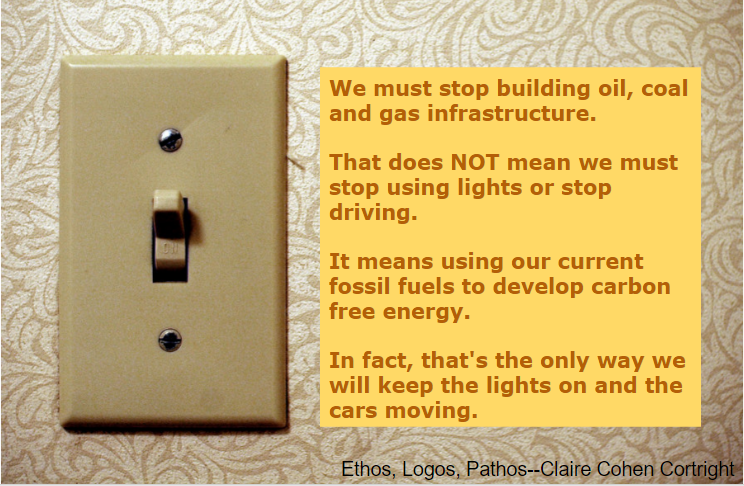
And we need to fight a war now. We have loads of solar panels and wind turbines to churn out. We have nuclear R&D to accomplish. We have a HVDC grid to build. We have smart grid technology to develop. We have gardens to grow. We have replacement for concrete to discover. We have planes, trains and automobiles to build that move without fossil fuels. We have energy storage R&D to do. We have to figure out how to accomplish widespread negative emissions. We have sea level rise to address. We have extreme weather to defend against. We have a war to fight. And we will need to do whatever it takes to win that war.
And here is my point: it WILL involve decisions that people on the left do not necessarily like. I don't like the idea of cost-plus contracts to GM or Boeing or Microsoft or, worse, Exxon Mobil. But what if they mean we can win the war?
If we are going to talk about WWII scale mobilization, we had better be ready to be exceedingly pragmatic. When we talk about WWII scale mobilization, we are talking about TOUGH choices. Not just for someone like Mitch McConnell or Jim Inhofe. Not just for Barack Obama or Hillary Clinton. Tough choices for us all.
I propose that those choices be faced with the guiding principle that cutting emissions and preserving a livable world must take higher priority than retribution, ideology or righteousness. Bill McKibben is absolutely right. We CAN get to zero emissions by 2035 or 2050. But no one should think it will come lightly or easily.