Sunday, October 23, 2016

Bill McKibben is more like Hillary Clinton than you realize.

Bill McKibben
"I periodically remind myself of what President Franklin D. Roosevelt told labor leaders who urged him to enact progressive legislation after his 1932 election: 'I agree with you. I want to do it; now, make me do it.'” --Henry Weinstein

A POTUS represents about 320M people.  They cannot stray too far afield of what they perceive are the goals and interests of those 320M people.  In fact, it is their OBLIGATION not to stray too far.

All leaders must look to their constituencies to define the boundaries of what they can and should accomplish.  Sometimes this is frustrating.  In climate change, we want them to end oil, coal and gas, now...as in yesterday now.  But in asking them to do that, we must recognize the limits are not what they stand for.  The limits are in what we stand for.

This is true even among those that we hold as most principled.  Bill McKibben is a fierce climate activist.  His dedication to cutting carbon emissions cannot be in doubt.  Savvy, capable, driven, principled and fully committed.  However, like any leader, he is answerable to his constituency.  (He doesn't have the same constituency as a POTUS, of course.  His is made up of climate activists.)  He is answerable to that constituency, even to the point of having a different public stance from his private one:

"After McKibben gave his rousing speech to an enthusiastic audience, I was able to grab him for a moment in back of the little makeshift stage. I asked him about nuclear power. He admitted that nuclear was going to be necessary if we were ever to reduce the amount of carbon in the atmosphere. “Why don’t you come out favorably in public for nuclear power, then?” I asked. He surveyed the hillside, almost half the people crusading against Vermont Yankee. “If I came out in favor of nuclear,” he said, “it would split this movement in half.”
So there you have it. McKibben, like many other environmentalists, knows in his heart that there isn’t much chance of reducing carbon output without nuclear. But he does not want to be caught saying so in public."   http://www.realclearenergy.org/articles/2015/11/12/how_about_suing_bill_mckibben_for_racketeering_108880.html
Here is our reality.  We must move almost 320M Americans to stop using fossil fuels.  We must move 7.4B human beings across the globe.

We don't all agree on things.  We don't all share the same values.  This is not easy.  This is HARD.

And our leaders can only lead us where we will follow.  That is not their failure or success.  It is ours.

Saturday, October 22, 2016

Climate To The Left of Me? Climate To The Right.

Hillary Clinton
Climate change is not caused by capitalism. Climate change is not caused by political corruption. Climate change is not caused by plutocracy.  

Climate change is caused by rising greenhouse gas emissions.

Anyone and everyone that remotely claims to understand or "believe in" climate change, needs to accept that we must cut emissions.

And, anyone that claims to understand climate change must also accept that we are out of time.  We must get to zero emissions by 2050 just to have a moderate chance of staying under 2C, by even the most optimistic projections.  That means building the infrastructure we need to get to zero today.  In our current system.  

We don't have time to remake our political system first. We don't have time to end political corruption first. We don't have time to solve class, LGBT, gender or racial injustice first.

No.  We don't have time.

If we care about the poor, if we care about women, children, the LGBT community, or minorities, if we care about our government, if we care about our children, if we care about animals and plants, if we care about anything that we have in our lives, we must place the utmost emphasis on cutting emissions.  Every single thing we know or love is jeopardized by climate change. 

We are out of time. And we MUST end carbon emissions. NOW.

As climate solutions go, I prefer the revenue neutral carbon fee and dividend. But a cap and trade can work. A carbon tax swap can work. A revenue raising carbon tax can work. Subsidies for renewables and ancillary infrastructure can work. Nuclear can work. Local, state and federal regulations can work. Private corporate investment can work. Public-private partnerships can work.  Religious edicts can work.  

I will take any and all of the above.

And anyone that claims to understand climate change will too. 


Michael Brune
Michael Brune and the Sierra Club, along with other environmental groups that opposed a carbon tax in Washington, have just demonstrated that they don't understand that.  (Brune cited that the carbon tax wasn't strong enough for various constituents in Washington with whom the left is allied, despite the fact that it includes a payment up to $1500/year for the poor).

People unwilling to vote for Hillary Clinton, who has strong plans for renewables and efficiency, the grid, storage, and load-shifting necessary to renewables, as well as for incentives for states to cut emissions, have demonstrated that they don't understand that.

Yes, we need plans to keep it in the ground.  A price on carbon is accepted as one of the best ways to do that.  And, yes, Hillary Clinton has been generally mum on a price on carbon because she does not see it as politically viable. 
(This is the statement from her campaign back in July:  "'Sec. Clinton would welcome working with Congress to address this issue but she also believes it is too important to wait for climate deniers to listen to science,' Trevor Houser, a Clinton campaign energy policy adviser said... 'That's why she is focused on a plan she can implement from Day 1.'")
Apparently, like most of us, she assumed it wasn't politically viable because of science denial in the GOP. 

One could guess that the left also might block a carbon price if it failed to raise revenue and spend money on renewables.  But no one would have guessed that it wouldn't just be the left, it would be the environmental left blocking a carbon tax. That is shocking. 

Think about that for a moment.  

The leaders in our country on climate...the people who are supposed to know most clearly that we are in dire straits...the people who should know that we must put cutting carbon above all else in order to protect all that we love...they don't get it.  

If the left doesn't get it?  That leaves the center and the right.  And you know what?  I predict that the center and the right will take ownership of cutting carbon before the left ever figures out how to stop squabbling. And the left will be stunned when they've lost on this issue. 


Carlos Curbelo
Bob Inglis
People like Bob Inglis  (former Representative and founder of the Republican carbon tax advocacy group RepublicEn) and Carlos Curbelo (Republican representative and co-founder of the bipartisan Climate Solutions Caucus) are waiting in the wings for that day.  

And you know who else may be predicting the same thing?  Hillary Clinton, who thinks that same none-of-the-above-energy crowd should "get a life." 


(Her leaked comments:  “They come to my rallies and they yell at me and, you know, all the rest of it. They say, ‘Will you promise never to take any fossil fuels out of the earth ever again?’ No. I won’t promise that. Get a life.
Clinton continued: “I’m having conversations in these town halls and these meetings I’m having with a lot of people who break into my meetings, they hold up posters, they scream at me, and all the rest of that: ‘Stop extracting fossil fuels, stop extracting on public lands, come out against nuclear, coal’ you name it.") 

No coal, no oil, no gas, no nuclear...that is not reasonable if you want to lead 320M people who have homes to heat unless you build renewables and infrastructure to support renewables first.  People wonder why she doesn't support a carbon tax. Well, hell, the environmentalists on the left can't even seem to get it together to do that. 

So what is she doing?  She is looking to address climate while speaking the right's language--becoming the clean energy superpower of the world. And not only that, she is doing it with the support and advice of people with a whole lot of experience dealing with climate and energy (Al Gore, John Podesta, Jennifer Granholm, just to name a few).
"Climate change is an urgent threat and a defining challenge of our time. It threatens our economy, our national security, and our children’s health and futures. We can tackle it by making America the world’s clean energy superpower and creating millions of good-paying jobs, taking bold steps to slash carbon pollution at home and around the world, and ensuring no Americans are left out or left behind as we rapidly build a clean energy economy."  https://www.hillaryclinton.com/issues/climate/

Well, someone's got to speak about climate in language the right understands.  The left sure isn't. 

And it looks like that someone is Hillary Clinton.

And you know what?  I am with her.

Saturday, October 8, 2016

Hillary Clinton Is Talking Climate-Do We Hear Her?


There continues to be a sense that while Hillary Clinton does have comprehensive plans for clean energy, she isn’t talking about climate change enough.  A good friend of mine expressed concern that she doesn’t really prioritize it.  He said “I feel invisible.”  Perhaps this reflected a sense that she isn’t really listening and doesn’t really hear how bad it is, how important it is.

The political process and the wrangling can make us all feel invisible.  And, certainly, Hillary Clinton has a lot on her plate.  Climate sometimes seems to get lost.  Without a doubt, moderators are not raising it.  Demoralizing, really.

However, while busy addressing Trump, she is still managing to raise climate.  Her use of climate as a wedge issue in the first presidential debate was fantastic.  Of course, she was busy in that debate making sure Trump was on the defensive in many areas.  Seeing climate as one was very gratifying.
 
But she is also raising climate in ads like the one above and in stump speeches. NPR has analyzed and annotated Clinton’s stump speeches, based on a typical one.  This is the speech she regularly gives, with subtle changes for each occasion.

I have excerpted here the portions relevant to climate change:

“We're going to make the biggest investment in new jobs since World War II.
Infrastructure jobs like those here at the port. Our roads, our bridges, our tunnels, our ports, our airports, they need work and there are millions of jobs to be done. And in addition to what you can see, what about our water systems, our sewer systems? We need a new modern electric grid to be able to take in clean, renewable energy that can then move us toward that future we seek.
I have a plan to install a half a billion solar panels by the end of my first term. And enough clean energy to power every home in America by the end of my second term. And I want young people especially to be part of this, to be in science, technology, engineering, manufacturing, creating this future that will determine the quality of your lives and the competitiveness of our economy.
...
Another threat to our country is climate change. 2015 was the hottest year on record, and the science is clear. It's real. It's wreaking havoc on communities across America. Last week's hurricane was another reminder of the devastation that extreme weather can cause, and I send my thoughts and prayers to everyone affected by Hermine. But this is not the last one that's going to hit Florida, given what's happening in the climate. Nobody knows that better than folks right here in Tampa and in the broader region. Sea levels have been rising here about an inch per decade since the 1950s. At the rate we are going, by 2030, which is not that far away, $70 billion of coastal property in this state will be flooding at high tide. And whenever our infrastructure is threatened, so too is our homeland security. The next president will have to work with communities like Tampa's to prepare for future storms.
When I'm in the Oval Office, I'm going to work with local leaders to make smart investments in infrastructure to help protect regions from flooding and other effects of climate change. I'm going to continue to continue to work on the international and national level to try to turn the clock back, to stabilize and reduce emissions even more, to try to gain more time. But we're going to have to begin working immediately on mitigation and resilience and prevention as well.
And what about Donald Trump? Well, he doesn't even believe in climate change. He says it's a hoax invented by the Chinese. And he says, 'You can't get hurt with extreme weather.' Now, this is the same guy who at one of his golf courses in some coastal place has demanded that a seawall be built to protect his golf course from rising tides. So it's all fine if it affects Donald, but if it affects the rest of humanity, he could care less. If it affects people to lose their homes or their businesses that took a lifetime to build, it doesn't matter to him. When it comes to protecting our country against natural disasters and the threat of climate change, once again Donald Trump is totally unfit and unqualified to be our president.”
Hillary Clinton has a goal of cutting emissions 80% by 2050.  The same goal of 80% by 2050 that Bernie Sanders had.  Certainly, her plans do not go far enough.  But 80% by 2050 is a strong goal.

Hillary Clinton has policy plans to develop clean energy, to build a new grid to support that clean energy, to ensure that there is climate justice in building resilience to withstand climate impacts and in accessing the opportunities for jobs building a green economy, to support coal communities as they transition to carbon free economics, to increase building efficiency, to electrify our automobile fleet… (Also see David Roberts' great summary of Hillary Clinton's climate policies here.)

Hillary Clinton has created a transition team that includes co-chair Jennifer Granholm, who has long advocated for clean energy challenge grants and is an aggressive advocate for building a green economy.  The team also includes Neera Tanden, the president of Center for American Progress (CAP).  The same CAP that created and sponsors Think Progress and Climate Progress, with its own Joe Romm.  These women answer to John Podesta, founder of CAP and head of Clinton's campaign. (As David Roberts explains, he was a driver for aggressive climate action in the Obama second term.)

And she is talking about climate change, even amidst a busy campaign understandably focusing on the threat that is Donald Trump.

Perhaps we are not invisible; perhaps she is hearing the climate scientists and energy policy experts and climate journalists and activists.

Perhaps it is that we are not hearing her.

I suspect that this might be related to "the gap" described by Ezra Klein:

"Given where both candidates began, there is no doubt that Bernie Sanders proved the more effective talker. His speeches attracted larger audiences, his debate performances led to big gains in the polls, his sound bites went more viral on Facebook.
Yet Clinton proved the more effective listener — and, particularly, the more effective coalition builder. On the eve of the California primary, 208 members of Congress had endorsed Clinton, and only eight had endorsed Sanders. 'This was a lot of relationships,' says Verveer.  'She’s been in public life for 30 years. Over those 30 years, she has met a lot of those people, stayed in touch with them, treated them decently, campaigned for them. You can’t do this overnight.'
One way of reading the Democratic primary is that it pitted an unusually pure male leadership style against an unusually pure female leadership style. Sanders is a great talker and a poor relationship builder. Clinton is a great relationship builder and a poor talker. In this case — the first time at the presidential level — the female leadership style won."


We in the climate movement are angry at the greed and mendacity of the fossil fuel interests.  We are scared and worried for our children's futures.  Quite simply, we want to hear outrage from Clinton.  And we don't.  This leaves many feeling unheard.  Feeling "invisible."

But, perhaps we are very much heard.  Perhaps she is listening.  Perhaps she is developing the right relationships for action.  Perhaps we just don't have an ear trained to hear her.


Monday, October 3, 2016

Climate Change Denial is for Losers.

The debate last week between Trump and Clinton was jam packed.  A great deal of the punditry since has rightly focused on how skillfully Clinton managed to expose Trump as an undisciplined bully while still conveying her own strengths and capacity to be commander-in-chief.

Less explored is the role of climate change in those 90 minutes.

No questions were asked on climate change.  Climate change could have gone without notice, yet again.  The widespread climate impacts we are already experiencing, the news rolling in that we have less time than we thought to end fossil fuel use, the benchmark 400ppm passed (likely with finality), the plummeting prices of renewables, the pipelines being blocked, the state struggles with nuclear and energy policy in general, the need for transmission and storage, for EVs, for clean energy…  The world is grappling with climate change and, yet, not one single question.

That would be the end of the story.  Except, it is not.

Within her first statement, just 3 minutes and 22 seconds after Lester Holt began this event, Hillary Clinton was raising clean energy.  Once again, she was demonstrating that clean energy is central to her platform.  Wise messaging consistent with the experts:  focus on solutions, not doom.  She has been consistent in that.

However, Hillary Clinton clearly had another specific goal last Monday that had little to do with climate policy.  She was going to put Donald on the defensive.  She was going to force him to become indignant, to get angry, to deny undeniable bad behavior.  She did it all night.

But what did she think was the best way to start?  What would be the best way to put Donald on the defensive?  Tax returns?  Rape charges?  Among the very first attacks was this:

“CLINTON:  …They've looked at my plans and they've said, OK, if we can do this, and I intend to get it done, we will have 10 million more new jobs, because we will be making investments where we can grow the economy. Take clean energy. Some country is going to be the clean- energy superpower of the 21st century. Donald thinks that climate change is a hoax perpetrated by the Chinese. I think it's real.
TRUMP: I did not. I did not. I do not say that. [Yes, he does.]
CLINTON: I think science is real.
TRUMP: I do not say that.
CLINTON: And I think it's important that we grip this and deal with it, both at home and abroad. And here's what we can do. We can deploy a half a billion more solar panels. We can have enough clean energy to power every home. We can build a new modern electric grid. That's a lot of jobs; that's a lot of new economic activity.”

Hillary Clinton just recognized and signaled that climate change is a wedge issue.  No matter how anyone may feel about her, we all recognize that Hillary Clinton is a skilled politician that responds to political will.  And she, here, both recognized and signaled that climate denial is indefensible.  It is so unacceptable that Donald Trump must deny his hand is in the cookie jar, though the crumbs are all over his face.  Climate denial is so bad that it is safe to use as bait for pushing Donald to feel insecure.  Donald wants to present as a winner.  And here, it became clear, climate denial is for losers.

Even Donald recognized that.

Saturday, September 24, 2016

If you are scared of a zero carbon economy, you are confusing "carbon free" with "climate change."

Bill McKibben:   "[I]f our goal is to keep the Earth’s temperature from rising more than two degrees Celsius—the upper limit identified by the nations of the world—how much more new digging and drilling can we do?

Here’s the answer: zero.
That’s right: If we’re serious about preventing catastrophic warming, the new study shows, we can’t dig any new coal mines, drill any new fields, build any more pipelines. Not a single one. We’re done expanding the fossil fuel frontier. Our only hope is a swift, managed decline in the production of all carbon-based energy from the fields we’ve already put in production.
... 
'Managed decline' means we don’t have to grind everything to a halt tomorrow; we can keep extracting fuel from existing oil wells and gas fields and coal mines. But we can’t go explore for new ones. We can’t even develop the ones we already know about, the ones right next to our current projects." 
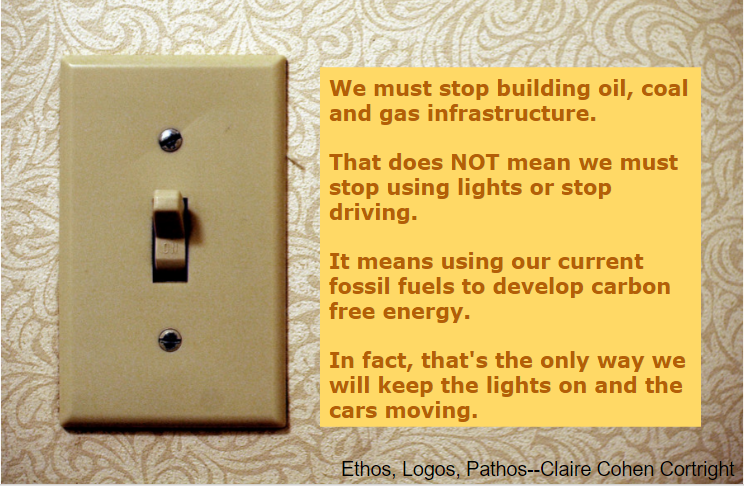
Action on climate does not mean living in caves.

Action on climate does not mean hunting around in the dark.

Action on climate does not mean living without power.

That's what happens if we DON'T act on climate.

Friday, September 16, 2016

An Open Letter to My Children

A wonderful project, called Dear Tomorrow, is collecting letters from people to their children, and others, who will be living in the future.  The letters will be held in a time capsule and released in 2030 and in 2050.  I had to write mine.  It's not an easy task.  My own children are alternately afraid of a Trump presidency and of creepy noises.  One foot in childhood and one foot in adulthood.  I share my fears and hopes with them, but I am wary of overwhelming them with the worst.  They have lives to lead, and hearts to break and jokes to tell.  They deserve to keep that.  Here is my letter.  I will share it with them today and submit it to the project.


Dear C and K,

I love you both.  

I want the world for you.  I have always wanted the world for you.  I want for you to love and laugh and live.  From the day each of you came into my life, I have tried to surround you with all that is good.  When you were infants, I played Mozart's music and decorated with vibrant colors, We explored the world with little special trips to the zoo and the woods and the library.  Even the grocery store was an adventure.  As you grew, I sent you to the Montessori school and then to dance because it was best for you.  I have made sure you had holidays and that I created traditions to make them special.

I want to continue to do that for you.   Your needs have changed over time, but the fact that you have needs has not.  You will need to build a means of making an income, you will need food on the table, you will need homes, you will need time and space to enjoy yourselves, to love, to laugh and to live.

So as you stepped out of the nursery, and I looked around at the wider world, I realized that Mozart's music and vibrant colors are no longer how to create the world I want for you. Something more dire is in its way.  Climate change is threatening everything I have to offer you and it is hurtling towards us.

Now, as you move forward, and I fear for what is coming as the planet warms, I read and try to make sense of how we will be impacted.  Anticipating the challenges.  Protecting resources to give you so that you can handle those challenges.  I look at our house, at 1300', with space for growing food and with water that is not subject to fracking and has never failed from drought, and I think I should keep it for you.  I consider the skills you might need, and how to generate resources for yourselves when I can no longer do that.  

I cry sometimes, for the things I know you will not have.  There will be terrible heat waves and sea level rise will drive people from the coasts to where we live.  Crops won't grow as well, so food costs will go up and means of making an income will likely go down.  Little things that aren't really so little will disappear, like coffee and chocolate, taking our traditions with them.  Refugees will come to our shores, and refugees will move within our own borders.  There will be mold growth everywhere.  Diseases like Lyme and Zika will have company.  Civil strife may drive other problems and disrupt your lives.  The world will be a terrifying place.  How terrifying?  I don't know.  But it won't be all Mozart and crib toys.

So what is a mom to do about it?  

Well, teach you the most important things.  The most most most important thing?  There is no such thing as "winning" or "losing" at life.  There are wins and losses.  But your life's journey is not a game to win or lose.  It is your journey.  Yours.  Every generation before you has faced struggles, pain and hardship.  And yours will too.  

But every generation before you has had a chance to love, to laugh and to live.  Take yours.  Take it.  Love.  Laugh.  Live.

But know this.  Loving, laughing and living does not mean saying "screw it" to life's challenges.  It means taking them on.  It means caring enough about your world and your life to try to make it better, even when it is terrifying.

I don't know if my efforts on climate can truly impact the trajectory of carbon emissions over the next century.  But I want you both to know this.  Every letter I have ever written, every meeting I attended, every article I read, every post I made to move others, every item I reused, every degree I turned the heat down, every load of laundry I hung dry, every luxury I didn't buy and when I am able, every arrest I will subject myself to, these all are the point.   I work on climate because I love you. 

And when you walk out the door on your own, I have one thing to insist on:  whatever you choose to do, do it out of love.  If you do, then whether you succeed or not, your actions have mattered.  Don't ever let anyone tell you your actions don't matter.  Every single thing you do matters.  You matter.

Whatever comes, please know that my actions are yours to keep, and carry with you.  Please let them hold you close when you need them.  It is the most important thing I have to give you, in the end.

With all my love, yours to carry,

Mom

Sunday, September 11, 2016

World War II Scale Mobilization


Climate change is here and it is urgent.  Urgent as in really really really dire.  As I discussed in a previous post, IPCC projections show a 50% chance of staying under 1.5C warming if we get to zero emissions by 2035 and a 66% chance of staying under 2C warming if we get to zero emissions by 2050.

Bill McKibben wrote an excellent piece last month laying out what we need to do to get to zero emissions...a World War II Scale Mobilization to fight climate change.  He did a great job explaining that winning a war is about building weaponry and infrastructure as much as it is about fighting.  He discussed how much needs to be built to fight climate change.  (While I do not completely agree with his reliance on Jacobsen's work to such a degree, his point is well made and whether we rely 100% on renewables or to some lesser extent, we have a lot to get done in a short amount of time).

Then he turned to a discussion of what a World War II Scale Mobilization looks like.  This was excellent.  We must all take a long hard look at what that really means.  Easy to say the phrase and give an air of meaning business, but getting down to brass tacks means figuring out precisely what that entails.
"Turning out more solar panels and wind turbines may not sound like warfare, but it’s exactly what won World War II: not just massive invasions and pitched tank battles and ferocious aerial bombardments, but the wholesale industrial retooling that was needed to build weapons and supply troops on a previously unprecedented scale. Defeating the Nazis required more than brave soldiers. It required building big factories, and building them really, really fast...
According to the conventional view of World War II, American business made all this happen simply because it rolled up its sleeves and went to war. As is so often the case, however, the conventional view is mostly wrong. Yes, there are endless newsreels from the era of patriotic businessmen unrolling blueprints and switching on assembly lines—but that’s largely because those businessmen paid for the films. Their PR departments also put out their own radio serials with titles like “Victory Is Their Business,” and “War of Enterprise,” and published endless newspaper ads boasting of their own patriotism. In reality, many of America’s captains of industry didn’t want much to do with the war until they were dragooned into it."
McKibben goes on to explain that "dragooned into it" meant government agencies directing industry action:
 “'It was public capital that built most of the stuff, not Wall Street,' says Wilson. 'And at the top level of logistics and supply-chain management, the military was the boss. They placed the contracts, they moved the stuff around.' The feds acted aggressively—they would cancel contracts as war needs changed, tossing factories full of people abruptly out of work. If firms refused to take direction, FDR ordered many of them seized. Though companies made money, there was little in the way of profiteering—bad memories from World War I, Wilson says, led to 'robust profit controls,' which were mostly accepted by America’s industrial tycoons. In many cases, federal authorities purposely set up competition between public operations and private factories: The Portsmouth Naval Shipyard built submarines, but so did Electric Boat of Groton, Connecticut. 'They were both quite impressive and productive,' Wilson says."
Let's tease that apart.  "Public capital built most of the stuff... [C]ompanies made money."  Why exactly did "America's industrial tycoons...accept 'robust profit controls'"?  Well, the answer might be in what those industrial tycoons got in return.  Andre Tartare, with Bloomberg:
"To win WWII, the U.S. economy had to be re-tooled to churn out airplanes and tanks alongside (or, in lieu) of washing machines and cars, while at the same time developing new technologies, such as the atomic bomb. Government spending — often in the form of cost-plus contracts to the risk-averse private companies operating the factories and mines — peaked at nearly 43 percent of U.S. gross domestic product in 1943 and 1944." 
A simple definition of cost-plus contract:  "A cost-plus-fixed-fee contract is a cost-reimbursement contract that provides for payment to the contractor of a negotiated fee that is fixed at the inception of the contract... This contract type permits contracting for efforts that might otherwise present too great a risk to contractors.."  That's right.  The corporation takes none of the risk in research and development.  Guaranteed profit.  No risk.  Government takes the risk.

Military and defense contractors.  Gun manufacturers.  Airplane and auto manufacturers. Profiteering?  Maybe not in the sense of making exorbitant profit margins. But they weren't treated too shabbily.  No risk R&D and guaranteed profit is nice.

Don't get me wrong.  I don't think it was a bad move.  We needed to fight a war.  And win a war.  And if IBM and Boeing and others profited by it unfairly, well, such is life.  We had a war to fight and win.

And we need to fight a war now.  We have loads of solar panels and wind turbines to churn out.  We have nuclear R&D to accomplish.  We have a HVDC grid to build.  We have smart grid technology to develop.  We have gardens to grow.  We have replacement for concrete to discover.  We have planes, trains and automobiles to build that move without fossil fuels.  We have energy storage R&D to do. We have to figure out how to accomplish widespread negative emissions.  We have sea level rise to address.  We have extreme weather to defend against.  We have a war to fight.  And we will need to do whatever it takes to win that war.

And here is my point:  it WILL involve decisions that people on the left do not necessarily like.  I don't like the idea of cost-plus contracts to GM or Boeing or Microsoft or, worse, Exxon Mobil.  But what if they mean we can win the war?

If we are going to talk about WWII scale mobilization, we had better be ready to be exceedingly pragmatic. When we talk about WWII scale mobilization, we are talking about TOUGH choices.  Not just for someone like Mitch McConnell or Jim Inhofe.  Not just for Barack Obama or Hillary Clinton.  Tough choices for us all.

I propose that those choices be faced with the guiding principle that cutting emissions and preserving a livable world must take higher priority than retribution, ideology or righteousness.  Bill McKibben is absolutely right.  We CAN get to zero emissions by 2035 or 2050.  But no one should think it will come lightly or easily.